Showing posts with label insects. Show all posts

Wednesday, October 18, 2017

Didn't Find a Chrysalis on the Milkweed (or butterfly weed)


I did bump into a Milkweed Beetle. One of these days I will see the monarch's chrysalis. At least I hope so.

Sunday, October 8, 2017

Some Flower Visitors (Besides Me) From the Week


A monarch that hasn't headed south yet for the winter.


A fly that looks like a bee, possibly in the Syrphus genus.


And just one of the Painted Ladies from Friday mornings butterfly show. I wonder if these guys are migrating south now too?

Saturday, September 30, 2017

Tuesday, September 12, 2017

The Sunflower House at the Children's Museum


The Sunflower House at the Long Island children's museum looks like a fine place to sit and read a little book, maybe even a book titled The Sunflower House about a boy who plants some tall sunflowers in a circle. (If your legs are on the small side, that is).


Or perhaps bump into a ladybug.


Tuesday, August 1, 2017

Friday, July 28, 2017

Spicebush Swallowtail at Summersweet!!!


Looks like I was in the right place at the right time to catch a glimpse of this suh-weet Spicebush Swallowtail.

Thursday, July 27, 2017

Entomology Photo Safari at Hofstra


I went on an entomology photo safari at Hostra and the cool thing was (yeah, I just put the words cool and entomology in the same sentence) I didn't even have to get a plane ticket to go on this adventure. I just had to stroll over to the Joe Pye-weed to discover some pollinators, like this sweet Monarch butterfly.


The Summersweet was another local joint that was jumping, with a variety of bees and wasps zipping in, out and milling about. There I had chance encounters with two new species. The first was a very small butterfly, which would only reveal enchanting flashes of blue while in flight. Since it didn't give me its name and wasn't wearing a name tag, after doing some hunting around I am going to call it a Summer Azure. (Thankfully, I was the only one on today's photo safari, so I'm safe doing this, as I just read over at the North Jersey Butterfly Club that all it takes is one Azure and two entomologists for a butterfly ID smackdown to spark, or at the very least a "spirited battle". Who knew entomologists were such brawlers? Not me, thats for sure.)

Speaking of tough guys, the other new insect I met at the Summersweet seemed to be acting more like it was on the prowl than seeking some flower nectar. My immediate guess was that I had just photographed some kind of predatory fly. After some research, I'm going to call this one an assassin fly because assissin fly seems more threatening and apt (and badass) then another common name, the robber fly. If it is an assassin fly, it isn't exactly out to "rob" another insect's nest or eggs. Or purse. It's going for the kill.

Monday, July 17, 2017

Chasing Schmetterlings


At least once every summer you should find yourself spending part of the morning or afternoon chasing schmetterlings (which someone recently told me is the German word for butterflies). I was stalking some schmetterlings over by a bottlebrush buckeye yesterday afternoon, but only managed to capture this one Eastern Tiger Swallowtail, which I will say is male after consulting my favorite insect ID site bugguide.net, with the camera.

Thursday, June 8, 2017

A, My Name is Amsonia and My Husband's Name is..


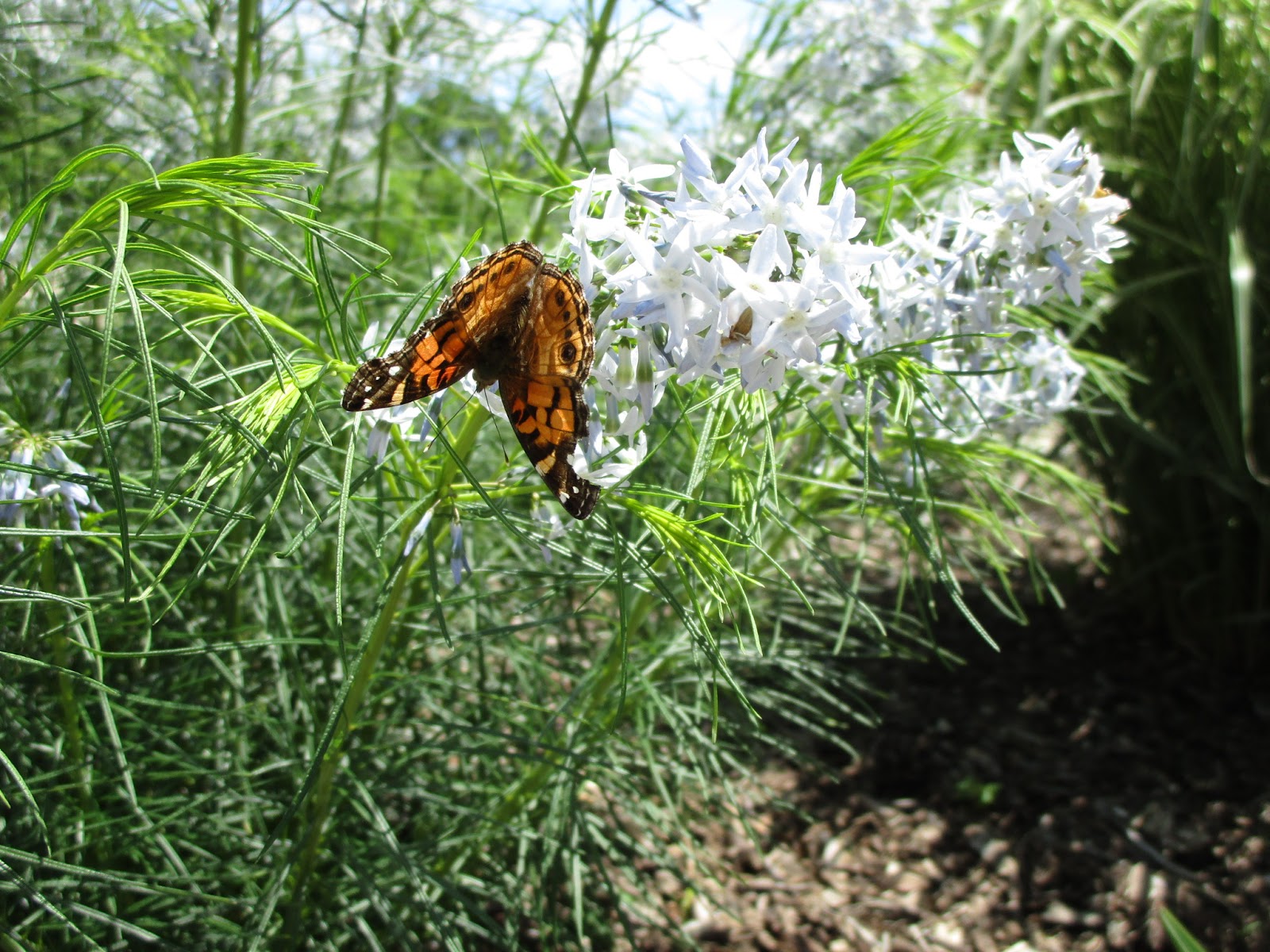
American Painted Lady?


One thing leads to another. If I hadn't fallen in love with gardening, I likely wouldn't know the name of the plant or the pollinator.

Monday, August 26, 2013

I Was Chasing a Hummingbird Moth

But wound up with a skipper and a wasp. (The hummingbird moths outwit the smartphone camera's capabilities, with their rapid wing movement.) The wasp, I believe is Monobia quadridens, a returning visitor in the garden. I can't remember when the hummingbird moths were flying at Floyd Bennett last year. But one summer I did see them in July, another mid to late august. This year, this weekend was the first I saw of these clearwing moths that fly by day visiting flowers. It's encouraging to see and then recognize at least a few returning pollinating visitors in the garden.
I think Monobia quadridens wasp with a backful of pollen on Monarda punctata, Floyd Bennett Field

Wednesday, November 30, 2011

Where I'll be Six Months From Now

Colorado Potato Beetle Eggs

Probably, stooped over or squatting, checking the underside of my potato, eggplant and tomato plants for the yellow clusters of eggs laid by the Colorado Potato Beetle. That doesn't sound like a lot of fun and it isn't really, but the good part is that if I remember to start doing this a little before Memorial Day (or to put it in the gardening year, sometime just after the tomato transplants go in the ground), I can manage an important pest in the garden.

And in five months? Definitely checking out Cayleb's tulip and bulb display at Brooklyn Botanic. It's different every year, but it's always around the same time. (That's what's awesome about gardens, this fantastic mix of regularity and surprise, and the chance each time round to learn a little more, try something different or just get better at the craft.)

Monday, November 28, 2011

The Ladybug in the News


Harmonia axyridis (methinks primarily from the M shaped markings on the pronotum. Not native.)

I check out the insects to charm my bug-loving nephew and I check out the insects because I am curious to know what pollinators are visiting my garden, but I also pay attention because it's important to know both your beneficials and your pests when you are gardening organically. And now that I know that the nine-spotted ladybug has recently been spotted on Eastern Long Island, there's also the possibility of seeing this native species so rarely seen in the last three decades to keep me interested.

Thursday, October 20, 2011

Another Day, Another Stage

in the life cycles of a butterfly and an allium. I bet the Black Swallowtail caterpillar above is nearly ready to overwinter in its chrysalis and man, if I could get a picture of that for my bug-loving nephew, it would be cool. I'm betting that he can figure out which end is which on this caterpillar just by looking at its legs.

Below: garlic chives going to seed.

Tuesday, October 18, 2011

A Skipper and a Native Bee

Skipper (possibly Fiery Skipper, Hylephila phyleus)

on one species in the garden today, Verbena bonariensis. The bloom that keeps on going and going and going. (and going and going and going maybe a little too crazy if you let it reseed, like I have, but I wouldn't want to miss the great pollinator show that comes with it.)


Metallic Green Bee, Agapostemon genus bee (female)


Native pollinator (metallic green bee) on Verbena bonariensis, Brooklyn

Monday, October 10, 2011

On Fennel

Late Instar of Black Swallowtail caterpillar

It's been an amazing few weeks for butterfly watching down at the community garden, today's caterpillar sightings included. If I'm lucky, I might get the chance to watch a chrysalis overwinter on some fennel volunteers (a pretty successful weed) in my garden or nearby. Today I saw a few different instars of the Black Swallowtail Butterfly in the caterpillar stage of its life cycle. While its unseasonably warm right now, I'm thinking that this must be the last generation of this species before our first frost here in New York. We'll see.

An earlier instar, methinks

Saturday, October 8, 2011

A Day of Big Sun


monarchs and Bob's asters,


bigtime bugwatching and getting nothing done in the garden. Just my kind of day.

Thursday, September 29, 2011

A Walk with Susan at The New York Botanical Garden

Salvia discolor, The New York Botanical Garden

It's like my oldest friend Christine always says, "wherever you go, there you are", an expression that can mean many things, one being that you cannot escape who you are no matter where you may run or how hard you try. I went to The New York Botanical Garden with Susan yesterday to learn about volunteering for their Citizen Science Tree Phenology program in the native forest after reading a post about the program on NYBG's blog Plant Talk. (Having an excuse to pay attention to the changes of plants throughout the seasons was an appealing idea and since we are doing this anyway, a spreadsheet might make us feel official in some way.) Of course, we got to the garden early so we could wander around in a botanical stupor.

Since wherever I go, therefore I am, I was drawn to the things and plants that capture my attention. So here, three things from yesterday's walk in one of New York City's most magnificent settings for learning about plants: Above, the beautiful Salvia discolor with its mix of contrasting light and dark colors and a visiting pollinator. The more you know about Salvias, the more you fall in love with these genus of plants, (well, at least for me this is true) and if there's something I love for sure, it is a late bloomer. Below, the leaf of a Sweetgum or Liquidambar styracifula, if one must use the proper botanical name. (I prefer this species' common name, if only because I don't have to google the spelling.) If I am my own citizen scientist and can mark the phenology of my own seasons, I can remember this day as the one where I saw my first red Sweetgum leaf of fall. Now I can go out and look for all the other colors this native tree will display this season.

And last, but certainly not least, the mix of the look of the wild with the cultivated, in a section of the new Azalea garden that aims to imitate a high elevation Appalachian bald through the mass planting of grasses and wildflowers.
While it is true that you will be yourself no matter where you are, it is also true that certain places and pursuits will bring you closer to the parts of yourself that you want to nurture. I owe a lot of the joy in my life (my current obsession with plants and gardening) to Joe and his insistance on us filling out an application for a community garden plot ten miles away from our home in Brooklyn. Building our first garden together four years ago and watching in fascination as our vegetables grew opened my eyes finally to the intricate world of the plants and pollinators outside around me. And getting to know that world more fully in these last few years by paying slow attention has made all the difference as I carry myself around to the places I need to go.

Wednesday, September 14, 2011

Mid-September Wednesday at Brooklyn Botanic, Last Year

Moonflower vine flower bud before opening, Cranford Rose Garden, Brooklyn Botanic, 2010

Wednesday mornings of last year were spent in the Rose Garden at Brooklyn Botanic along with my fellow horticultural interns and Sarah, the rosarian. On this particular Wednesday in mid-September, one year ago exactly, I remember standing with Ayana admiring the incredible beauty of the Moonflower vine and a flower bud getting ready to open, perhaps later that evening or the next. It was a day of bright sun. Dainty Bess, a hybrid tea I fell in love with, was blooming and some honey bees were visiting.


And over near the Children's Garden, the Nyssa was starting to turn. Perhaps it is the light of the end of this summer that has turned me nostalgic. But I have the feeling that I ought to visit Brooklyn Botanic to see what color that Nyssa is this year and take in some new moments of botanical bliss.

Tuesday, September 13, 2011

On Sedum, in a Garden in Brooklyn


Bees on sedum, Brooklyn Botanic

Last year in mid-September, it was the honey bee I noticed at Brooklyn Botanic digging on the sedum. This year, the bee again, but so much more. For instance, the wasp below. At this time of year, those things that are blooming, (for me garlic chives, goldenrod, aster and verbena bonariensis, among a few others) are swarming with hungry insects and it's an excellent time to get to know a few.

Below is a thread-waisted wasp, perhaps Prionyx parkeri. It feeds on nectar as an adult, but it is also a hunter of grasshoppers, which it feeds to its larvae. Now I know that grasshoppers are sweet-looking and that my nephew probably loves them, but it is also an herbivore. So this wasp, a predator of a plant-eater is a good guy in the garden.

Thread-waisted wasp on sedum, Floyd Bennett Field, Brooklyn

Monday, September 12, 2011

I Thought I Saw a Wasp

Lesser peachtree borer on Garlic Chives, Brooklyn

Keen to impress my bug-loving nephew with my mad bug-identifying skills, I pored over the shots of what at first glance I thought was a wasp in my garden. But the wings in the shot below reminded me of a certain hummingbird moth that I'm so fascinated by, so instead of seeking out information on wasp identification, I looked for a clearwing moth instead. Turns out that the insect visiting the garlic chives in my garden, is indeed a wasp imitating moth, but more importantly it's also an important pest for fruit farmers. Something to keep in mind, if I ever find myself so lucky as to own a piece of land with room for some fruit trees. If my research is correct, this is a male Lesser Peachtree Borer, Synanthedon pictipes, but as usual I'd be happy if I nailed the genus alone. The looking at bugs thing is similar to the looking at plants thing. The more you look, the more you will see and after some time spent looking hard at the small things around you, something does sink in.

Lesser Peachtree borer moth male, Brooklyn

I also thought I saw a bright green metallic bee and you know what? I did. Coud it be Agapostemon sericeus, one of our New York native bees? Perhaps. I'll call it at genus Agapostemon, until I know better.

Keep looking Aaron. There's so much to discover.

Female Agapostemon metallic green bee on Goldenrod, Brooklyn